Research should move.
Technical depth is useful when it changes the next decision: a clearer experiment, a better prototype, a stronger proposal, a more credible development roadmap.
RESEARCH.NODE / ACTIVE
MP Consulting connects research, education and project design to turn complex ideas into clear development paths, strong proposals and usable technical outputs.
CROSS-DISCIPLINARY / ONLINE
Technical depth is useful when it changes the next decision: a clearer experiment, a better prototype, a stronger proposal, a more credible development roadmap.
A course is valuable only if participants leave able to do something they could not do before. MP designs learning around practice, participation and reusable outputs.
Materials, sensing, fluidics, electronics, product constraints and funding strategy rarely exist in isolation. The interesting work happens at their interfaces.
DELIVERY.ARCHITECTURE / 4 LAYERS
The service architecture mirrors the way real innovation work unfolds: understand the science, structure the project, transfer the knowledge, and engineer the next step.
SCIENCE / FEASIBILITY / DEVELOPMENT
Deep-tech scouting, feasibility analysis, experimental planning, technology roadmaps and technical documentation for R&D programmes.
LEARNING / PRACTICE / TRANSFER
Professional courses, adult education and digital learning formats designed around participation, practice and outputs that learners can reuse.
CALL / CONSORTIUM / PROPOSAL
Concept notes, call-fit analysis, partner positioning, work packages, proposal writing and technical project-management support.
REQUIREMENTS / TRL / VALIDATION
Requirements, TRL strategy, prototype planning, validation logic and technical storytelling that help move an idea toward a credible product path.
COURSE.NODE / MP01 / ENROLMENT OPEN
From idea to a fundable European project concept.
A learning-by-doing programme for educators, adult education and VET staff, NGOs and civil-society professionals, international officers and emerging EU project coordinators. Participants work on a real organisational challenge and progressively transform it into a structured European project concept.
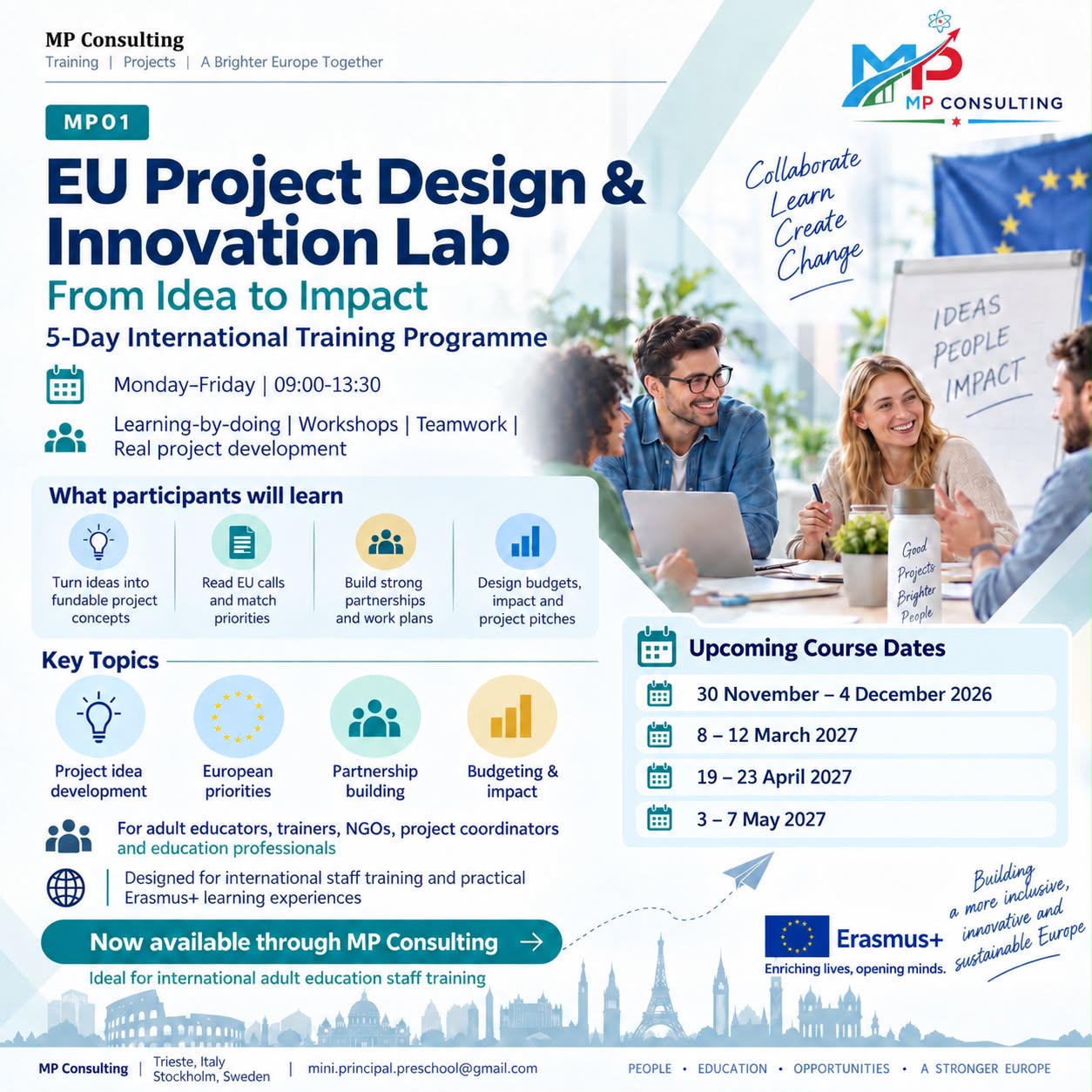
In 20 guided learning hours, participants learn to structure a strong project concept, test its logic, identify the right partnership, build an implementation architecture and prepare it for a later call-specific development process. The course does not claim to turn participants into experts in the detailed application rules of Erasmus+, Horizon Europe, CERV, Interreg or other programmes.
UPCOMING.SESSIONS / 04
International staff-training dates currently planned by MP Consulting. Locations include Trieste, Italy and Stockholm, Sweden.
PROGRAMME.SEQUENCE / 05 DAYS
Each day ends with a production gate: participants leave with concrete project evidence, not only notes.
Turn a real organisational need into a preliminary European project concept with evidence, target-group clarity, EU relevance, objectives and first partner logic.
Convert the Day 1 concept into a coherent intervention architecture linking objectives, activities, responsibilities, timeline, results, outcomes, impact and risk.
Build work packages, quality arrangements and a preliminary budget that reflect project activities, partner responsibilities and value for money.
Use a transferable innovation methodology that works across participant profiles: define what is genuinely new in context, redesign an activity around a real barrier, prototype an intervention, test transferability and convert it into a European project component.
Integrate the week, apply a common quality rubric, strengthen project logic, communicate the concept and define a realistic pathway to a programme-specific application.
INNOVATION / CONTEXT / PILOT / SCALE
Innovation may be a new method, combination, transfer, process, participation model or implementation approach — not only advanced technology.
European cooperation can be used to co-design, test, compare and refine an intervention across contexts before broader transfer.
Define what is core, what can be adapted and which conditions another organisation or country needs in order to use the intervention.
LEARNING.OUTCOMES / 06 COMPETENCE AREAS
Define a challenge, target group, evidence and a clear need.
Explain transnational added value and maintain a coherent intervention logic.
Formulate objectives and design activities, outputs, results and outcomes.
Identify complementary partners and assign roles by competence and capacity.
Structure work packages, timeline, budget, risk response and quality checks.
Define indicators, expected change, sustainability and communicate the concept clearly.
Participants leave with a coherent working package that can support a partner discussion, a call-screening exercise or a later programme-specific application process.
R&D.MAP / MULTI-DOMAIN
The value is often in the connection: materials affect sensing, sensing affects fluidics, fluidics affects electronics, and product constraints reshape the experiment.
Cartridges · sample handling · flow paths · dead-volume control
Electrochemistry · optical sensing · assay architecture
Nanostructures · plasmonics · SERS · surface engineering
Polymers · biopolymers · functional materials · processing
CAD logic · requirements · iterations · validation
Decision support · data interpretation · R&D workflow tools
DEVELOPMENT.LOOP
Start with constraints, evidence and the outcome that actually matters.
Translate the problem into a technical, educational or project structure.
Prototype, course, concept note, proposal, model or decision tool.
Use evidence to separate what works from what merely sounds plausible.
Leave with a concrete decision, not just a report.
CMD.01 · TECHNICAL LEAD
PHYSICS · NANOTECH · R&D
FOUNDER.PROFILE / ACTIVE
Physics and nanotechnology background combined with hands-on experience in microfluidics, biosensors, materials, prototyping and European R&D projects. The common thread is translating scientific complexity into something that can be built, tested, explained or funded.
CHANNEL.OPEN / READY
A course, an EU proposal, a technical concept, an R&D bottleneck or an early-stage idea — send the context and the objective.